Sakalar

Sakalar (ساکا, Saka; Śaka; Σάκαι, Sakai; Sacae; ,Sāi), Kuzeydoğu Avrasya stepleri ile Tarım havzasında yaşayan ve at yetiştirme, madencilik yapma kabiliyetleri geliştirmiş olan tarihi halk. Kaynakların genelde Sakaları Türkî[1]Herrmann. Das Land der Seide. s. 147.[2]unterländer, m. et al. ancestry and demography and descendants of iron age nomads of the eurasian steppe (2017)[3]Unterländer, Martina. Ancestry and demography and descendants of Iron Age nomads of the Eurasian Steppe. 3 Mart 2017, s. 14615.[4]Gnecchi-Ruscone, Guido Alberto. Ancient genomic time transect from the Central Asian Steppe unravels the history of the Scythians. 26 Mart 2021.[5]Karakoç, Eren. Tüm Kanıtlarıyla İskitlerin Türklüğü (Doç. Dr. Eren Karakoç). 1 Ocak 2019.[6]Sayın, Onur. (İskitlerin) Sakaların Menşei Meselesi.[7]Halil İnalcık-Osmanlı Tarihinde Efsaneler ve Gerçekler,sayfa 24:"Scyth'ler Bizans literatüründe Karadeniz'in kuzeyindeki Türk kavimlerine verilen addır."[8]Sakalar / Prof. Dr. Igor Vasilyeviç P'yankov 611-619[9]İlhami Durmuş,İskitler (Sakalar),S.21.[10]Anatole A.Klyosov, "The Principal mystery in the relationship of Indo-European and Türkic linguistic families,and an attempt to solve it with the help of DNA genealogy:reflections of onlinehome.us/turkic/60_Genetics/Klyosov2010DNK-GenealogyEn.html[11]Prof.Dr.Umay Türkeş Günay:Türklerin Tarihi Geçmişten Geleceğe Akçağ Yayınları 5.Baskı. S.51-69[12]Osmanlı Hukuku Prof Dr.Ekrem Buğra Ekinci Arı Sanat Yayınevi s.51[13]Medler ve Türkler Prof. Dr. Mehmet Bayrakdar AKÇAĞ YAYINLARI s.44-56[14]Sinop Üniversitesi SOSYAL BİLİMLER ENSTİTÜSÜ TARİH ANA BİLİM DALI GENEL TÜRK TARİHİ, Nihat ÇİNİ, İSKİTLER (SAKALAR) ÖN TÜRKLER (Yüksek Lisans Seminer Çalışması)[15]İran ile Turan. Hayali Milletler Çağında Avrasya ve Ortadoğu, Ötüken Yayınları, İstanbul 2019, 4. baskı.,S.151-156;S..215-240[16]Bozkır Kavimleri,Egemen Çağrı Mızrak,Ötüken Yayınları,S.265-287[17]Sanducci, A.. Ancient Scholars about the Turks and the Turkic Nations. The MEGA Edition.: Vol.1, 2.. WorldScholarlyPress, 27 Temmuz 2023.[18]KNOLLES, Richard. The Turkish History:Comprehending of the origin of that NATION, and the growth of the Ottoman Empire, with the LİVES and CONQUESTS of their feveral KINGS and EMPERORS. 1701, s. 341. ya da İrani[19]Britannica.[20]Beckwith, Christopher I. (2009). Empires of the Silk Road: A History of Central Eurasia from the Bronze Age to the Present. Princeton University Press. ISBN 978-0-691-13589-2.[21]Dandamayev, M. A. (1994). "Media and Achaemenid Iran". In Harmatta, János (ed.). History of Civilizations of Central Asia: The Development of Sedentary and Nomadic Civilizations, 700 B. C. to A. D. 250. UNESCO. pp. 35–59. ISBN 9231028464. bir halk olarak sayılmasının yanı sıra kimlikleri konusunda tartışmalar sürmektedir. Ancak Avrasya stepleri'deki kurganlarda bulunan kişilerin naaşları üzerinde son yapılan genom ve mitokondriyal DNA çalışmaları sonuçlarına göre, kurganlarda bulunan Saka naaşlarına genetik yakınlık gösteren kişilerin hepsinin günümüz Türki halklara mensup olan bireyler oldukları görülmektedir.[4]Gnecchi-Ruscone, Guido Alberto. Ancient genomic time transect from the Central Asian Steppe unravels the history of the Scythians. 26 Mart 2021.[22]Davidski. Eurogenes Blog: Genetic origins and legacy of the Scythians and Sarmatians. 3 Mart 2017.[23]Unterländer, Martina. Ancestry and demography and descendants of Iron Age nomads of the Eurasian Steppe. Nature Communications, 3 Mart 2017, s. ncomms14615.
Saka kelimesi Ahamenişler döneminden sonra Eski Farsçada kullanılmaya başlanmıştır. Grekçede Sakai olarak hitap edilen Sakalar ile İskitlerin çok yakın ve akraba bir halk olduğu ve ortak bir İskit-Sibirya kültürüne sahip oldukları kabul edilmekle beraber aynı halk olmadıkları düşünülmekte ve akademik çevrelerce İskit ve Sakalar genellikle akraba ama farklı halklar olarak sınıflandırılmaktadır.[24]"In modern scholarship the name 'Sakas' is reserved for the ancient tribes of northern and eastern Central Asia and Eastern Turkestan to distinguish them from the related Massagetae of the Aral region and the Scythians of the Pontic steppes. These tribes spoke Iranian languages, and their chief occupation was nomadic pastoralism."[25]Kramrisch, Stella. Central Asian Arts: Nomadic Cultures. Encyclopædia Britannica Online.
Tanrı Dağları ve Fergana Vadisi arasında yaşayan Sakaların Bir kısmı Ahamenişlere itaat ederek Yunan-Pers Savaşına da katılmışlardır. MÖ 2. yüzyılda Orta Asya'dan güneye inerek Baktriya'yı yendikten sonra Hint yarımadasına girmişlerdir. Bunun sonucunda Hint-İskit Krallığı doğmuştur.
Kökenleri
Günümüzde, Sakaların kökenlerinin Türkî ve İrani ilişkili olduğu akademi içerisinde en yaygın görüşler arasındadır,[26]Religions of the ancient world : a guide. Harvard University Press, 2004, s. 197.[27]Dalby, Andrew. Dictionary of languages : the definitive reference to more than 400 languages. Columbia University Press, 1998, s. 278.[28]Dandamayev 1994, s. 37 "In modern scholarship the name 'Sakas' is reserved for the ancient tribes of northern and eastern Central Asia and Eastern Turkestan to distinguish them from the related Massagetae of the Aral region and the Scythians of the Pontic steppes. These tribes spoke Iranian languages, and their chief occupation was nomadic pastoralism."[29]Grousset, René. The empire of the steppes : a history of central Asia. Rutgers University Press, 1970, s. 29-31. Sakalar, bu açıdan Ön Türk halkı kökenli veya Doğu İran halkı kökenli veya ilişiği olduğu ya da Ön Türk toplumlarıyla ilişkili bir halk olduğuna dair görüşler ve iddialar bulunmaktadır.[8]Sakalar / Prof. Dr. Igor Vasilyeviç P'yankov 611-619[9]İlhami Durmuş,İskitler (Sakalar),S.21.[10]Anatole A.Klyosov, "The Principal mystery in the relationship of Indo-European and Türkic linguistic families,and an attempt to solve it with the help of DNA genealogy:reflections of onlinehome.us/turkic/60_Genetics/Klyosov2010DNK-GenealogyEn.html[11]Prof.Dr.Umay Türkeş Günay:Türklerin Tarihi Geçmişten Geleceğe Akçağ Yayınları 5.Baskı. S.51-69[12]Osmanlı Hukuku Prof Dr.Ekrem Buğra Ekinci Arı Sanat Yayınevi s.51[13]Medler ve Türkler Prof. Dr. Mehmet Bayrakdar AKÇAĞ YAYINLARI s.44-56[14]Sinop Üniversitesi SOSYAL BİLİMLER ENSTİTÜSÜ TARİH ANA BİLİM DALI GENEL TÜRK TARİHİ, Nihat ÇİNİ, İSKİTLER (SAKALAR) ÖN TÜRKLER (Yüksek Lisans Seminer Çalışması)[15]İran ile Turan. Hayali Milletler Çağında Avrasya ve Ortadoğu, Ötüken Yayınları, İstanbul 2019, 4. baskı.,S.151-156;S..215-240[16]Bozkır Kavimleri,Egemen Çağrı Mızrak,Ötüken Yayınları,S.265-287[30]Doç.Dr Karakoç, E. Tüm Kanıtlarıyla İskitlerin Türklüğü.
Yaşayışları
Savaşlarda kullandıkları en önemli silah, savaş baltası olmuştur. Ayrıca ok, yay ve kılıç da kullanılmıştır. Akraba olan İskit kalıntılarındaki at figürlerinin yoğunluğu da dikkati çekmektedir. Bu figürler göçmen bir kavim oldukları yönündeki tezleri bir hayli güçlendirmektedir.
Sanat
İskit kurganlarında çıkan eserler, medeniyette ileri olduklarını göstermektedir. Herodotos'a göre, "İskitler, çok medeni bir milletti. Gümüş işçiliğinde, dişçilikte ve çıkıkları sarmakta ustaydılar. İskit sanatında, hayvan üslubu önemli yer tutmuş ve at, geyik, kuş motifleri ağırlık basmıştır. Herodotos'un yazdıklarına göre Yunanlar, elbise teferruatlarını, gümüş ve altın at takımlarını İskitlerden öğrenmişlerdir.
Dil
Sakaca, genel olarak bir Doğu İran dili olarak ele alınır. Sakaca , ve Tomşuk gibi Tarım Havzasında hüküm sürmüş eski Budist krallıklar tarafından konuşulmuş ve dil bilimciler tarafından Kotanca ve Tomşukça da denen 2 adet şiveye ayrılmıştır.[31]Saka language. britannica.com. Dil hakkındaki neredeyse tüm kaynaklar Dunhuang el yazmalarından gelmektedir ve dilin kökenlerinin anlaşılması ve çözülebilmesi yaklaşık 2,300 metnin Harold Walter Bailey tarafından incelenmesi ve tercüme edilmesi sayesinde gerçekleşmiştir.[32]Susan Whitfield (2004). The Silk Road: Trade, Travel, War and Faith. London: British Library Press, 2004. Bu çalışmalar Hotan bölgesinde bulunan Sakaların dilinin Doğu İrani diller ile ilişkili olduğuna yönelik ihtimalleri arttırmıştır.[33]Ronald Emmerick, "Khotanese and Tumshuqese", in Gernot Windfuhr, ed., The Iranian Languages, Routledge, 2009
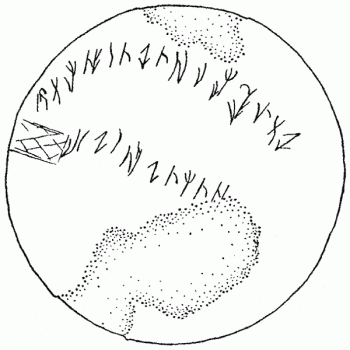
Bu metinlerin yanı sıra Esik Kurganında bulunan gümüş bir çanağın Sakacanın ilk örneği olabileceği dilbilimciler tarafından düşünülmektedir. Harmatta isimli ve çeşitli Farsi dillerin çözülmesinde rol oynamış dilbilimci, bu yazının Kharosthi alfabesi kullanılarak Kotan Sakacısında yazıldığını öne sürmüş olup okunuşu ve çevirisi şu şekildedir:[34]Harmatta, János. History of Civilizations of Central Asia: The Development of Sedentary and Nomadic Civilizations. UNESCO, 20 Ağustos 1994, s. 420-1.[35]"Harmatta [Harmatta 1999, p.411-412] appears as he has accomplished to solve the mystery of this "unknown language and alphabet" which covers a wide are from Alma-Ata to Merv, to Dest-i Navur and to Ay Hanum. According to Harmatta and Fussman, the alphabet can be traced back to the Karoshti alphabet; and the language written with this alphabet could have been a Saka dialect spoken by the Kushans. Harmatta who remarks on the resemblance of the letters to those in Orkhon-Yenisey states that due to some letters [...]. [...]. Fussman states that this Inscription is based on syllables, and notes its similarity to the Kharosthi alphabet, but he could not read it. Livsits asks whether this alphabet he calls as the "third official alphabet of the Kushan State" is the Saka alphabet or not. [...]. Livsits, on the other hand says that, further to the Issyk-kol alphabet, this alphabet is related not with the Kharosthi alphabet, but rather with the Aramaic alphabet [...]."
“za(ṃ)-ri ko-la(ṃ) mi(ṃ)-vaṃ vaṃ-va pa-zaṃ pa-na de-ka mi(ṃ)-ri-to ña-ka mi pa-zaṃ vaṃ-va va-za(ṃ)-na vaṃ. [Bu kap üzüm şarabı, pişmiş gıda ve taze tereyağı içerir, o kadar çok ki, ölümlü?.]”
Sakacanın Ön Türkçe ile ilişikili olduğu iddiaları da, özellikle Türkî araştırmacılar tarafından desteklenen bir savdır. Esik Kurganı'nda bulunmuş tabaktaki yazının Ana Türkçe ile ilişiği olduğu iddiaları bulunmaktadır.[36]Bozkır Kavimleri,Egemen Çağrı Mızrak,Ötüken Yayınları,S.123-126[37]Prof.Dr.Umay Türkeş Günay:Türklerin Tarihi Geçmişten Geleceğe Akçağ Yayınları 5.Baskı. S.51-60[38]Bozkır Kavimleri,Egemen Çağrı Mızrak,Ötüken Yayınları,S.265-273[39]The Turks. Volume 1: Early Ages. Part 3: Old nomads of the steppes: Scythian age in Eurasia. Prof. Dr. A. Chay - Prof. Dr. I. Durmus, Scythians, Yeni Türkiye, Ankara 2002, S.155, ISBN 975-6782-56-0 Tabaktaki Türk araştırmacılar tarafından iddia edilen Proto-Türkçe okunuşu ise şöyledir:[40]A. Amanjolov: Runic-like inscription from Saka's burial near Alma-Ata. "Bulletin of Academy of Sciences KazSSR", 1971, No 12 (320), s. 64-66; + A. Amanjolov: Materials and research on history of Ancient Türkic writing. Author's abstract of Ph. Doctor Dissertation, Alma-Ata, 1975, s. 48-52; + A. Amanjolov: Türkic runic graphics, 3. Alma-Ata, 1985, s. 31-39. + A. Amanjolov "History and Theory of Ancient Turkic Script", Almaty, "Mektep", 2003, s. 218-219.
Aγa, saηa očuq! Bez, cök! Boqun ičrä(r) azuq!
[Ağabey, sana (bu) ocak! Yabancıyı dize getir, yen! Halkta yiyecek (bol olsun)!]
Dış bağlantılar
Kaynakça
- 1.Herrmann. Das Land der Seide. s. 147.
- 2.unterländer, m. et al. ancestry and demography and descendants of iron age nomads of the eurasian steppe (2017)
- 3.Unterländer, Martina. Ancestry and demography and descendants of Iron Age nomads of the Eurasian Steppe. 3 Mart 2017, s. 14615. nature.com
- 4.Gnecchi-Ruscone, Guido Alberto. Ancient genomic time transect from the Central Asian Steppe unravels the history of the Scythians. 26 Mart 2021. science.org
- 5.Karakoç, Eren. Tüm Kanıtlarıyla İskitlerin Türklüğü (Doç. Dr. Eren Karakoç). 1 Ocak 2019. academia.edu
- 6.Sayın, Onur. (İskitlerin) Sakaların Menşei Meselesi. academia.edu
- 7.Halil İnalcık-Osmanlı Tarihinde Efsaneler ve Gerçekler,sayfa 24:"Scyth'ler Bizans literatüründe Karadeniz'in kuzeyindeki Türk kavimlerine verilen addır."
- 8.Sakalar / Prof. Dr. Igor Vasilyeviç P'yankov 611-619
- 9.İlhami Durmuş,İskitler (Sakalar),S.21.
- 10.Anatole A.Klyosov, "The Principal mystery in the relationship of Indo-European and Türkic linguistic families,and an attempt to solve it with the help of DNA genealogy:reflections of onlinehome.us/turkic/60_Genetics/Klyosov2010DNK-GenealogyEn.html
- 11.Prof.Dr.Umay Türkeş Günay:Türklerin Tarihi Geçmişten Geleceğe Akçağ Yayınları 5.Baskı. S.51-69
- 12.Osmanlı Hukuku Prof Dr.Ekrem Buğra Ekinci Arı Sanat Yayınevi s.51
- 13.Medler ve Türkler Prof. Dr. Mehmet Bayrakdar AKÇAĞ YAYINLARI s.44-56
- 14.Sinop Üniversitesi SOSYAL BİLİMLER ENSTİTÜSÜ TARİH ANA BİLİM DALI GENEL TÜRK TARİHİ, Nihat ÇİNİ, İSKİTLER (SAKALAR) ÖN TÜRKLER (Yüksek Lisans Seminer Çalışması)
- 15.İran ile Turan. Hayali Milletler Çağında Avrasya ve Ortadoğu, Ötüken Yayınları, İstanbul 2019, 4. baskı.,S.151-156;S..215-240
- 16.Bozkır Kavimleri,Egemen Çağrı Mızrak,Ötüken Yayınları,S.265-287
- 17.Sanducci, A.. Ancient Scholars about the Turks and the Turkic Nations. The MEGA Edition.: Vol.1, 2.. WorldScholarlyPress, 27 Temmuz 2023. books.google.com.tr
- 18.KNOLLES, Richard. The Turkish History:Comprehending of the origin of that NATION, and the growth of the Ottoman Empire, with the LİVES and CONQUESTS of their feveral KINGS and EMPERORS. 1701, s. 341. books.google.com.tr
- 19.Britannica. britannica.com
- 20.Beckwith, Christopher I. (2009). Empires of the Silk Road: A History of Central Eurasia from the Bronze Age to the Present. Princeton University Press. ISBN 978-0-691-13589-2.
- 21.Dandamayev, M. A. (1994). "Media and Achaemenid Iran". In Harmatta, János (ed.). History of Civilizations of Central Asia: The Development of Sedentary and Nomadic Civilizations, 700 B. C. to A. D. 250. UNESCO. pp. 35–59. ISBN 9231028464.
- 22.Davidski. Eurogenes Blog: Genetic origins and legacy of the Scythians and Sarmatians. 3 Mart 2017. eurogenes.blogspot.com
- 23.Unterländer, Martina. Ancestry and demography and descendants of Iron Age nomads of the Eurasian Steppe. Nature Communications, 3 Mart 2017, s. ncomms14615. nature.com
- 24."In modern scholarship the name 'Sakas' is reserved for the ancient tribes of northern and eastern Central Asia and Eastern Turkestan to distinguish them from the related Massagetae of the Aral region and the Scythians of the Pontic steppes. These tribes spoke Iranian languages, and their chief occupation was nomadic pastoralism."
- 25.Kramrisch, Stella. Central Asian Arts: Nomadic Cultures. Encyclopædia Britannica Online. britannica.com
- 26.Religions of the ancient world : a guide. Harvard University Press, 2004, s. 197. archive.org
- 27.Dalby, Andrew. Dictionary of languages : the definitive reference to more than 400 languages. Columbia University Press, 1998, s. 278. archive.org
- 28.Dandamayev 1994, s. 37 "In modern scholarship the name 'Sakas' is reserved for the ancient tribes of northern and eastern Central Asia and Eastern Turkestan to distinguish them from the related Massagetae of the Aral region and the Scythians of the Pontic steppes. These tribes spoke Iranian languages, and their chief occupation was nomadic pastoralism."
- 29.Grousset, René. The empire of the steppes : a history of central Asia. Rutgers University Press, 1970, s. 29-31. archive.org
- 30.Doç.Dr Karakoç, E. Tüm Kanıtlarıyla İskitlerin Türklüğü.
- 31.Saka language. britannica.com. britannica.com
- 32.Susan Whitfield (2004). The Silk Road: Trade, Travel, War and Faith. London: British Library Press, 2004.
- 33.Ronald Emmerick, "Khotanese and Tumshuqese", in Gernot Windfuhr, ed., The Iranian Languages, Routledge, 2009
- 34.Harmatta, János. History of Civilizations of Central Asia: The Development of Sedentary and Nomadic Civilizations. UNESCO, 20 Ağustos 1994, s. 420-1. books.google.com
- 35."Harmatta [Harmatta 1999, p.411-412] appears as he has accomplished to solve the mystery of this "unknown language and alphabet" which covers a wide are from Alma-Ata to Merv, to Dest-i Navur and to Ay Hanum. According to Harmatta and Fussman, the alphabet can be traced back to the Karoshti alphabet; and the language written with this alphabet could have been a Saka dialect spoken by the Kushans. Harmatta who remarks on the resemblance of the letters to those in Orkhon-Yenisey states that due to some letters [...]. [...]. Fussman states that this Inscription is based on syllables, and notes its similarity to the Kharosthi alphabet, but he could not read it. Livsits asks whether this alphabet he calls as the "third official alphabet of the Kushan State" is the Saka alphabet or not. [...]. Livsits, on the other hand says that, further to the Issyk-kol alphabet, this alphabet is related not with the Kharosthi alphabet, but rather with the Aramaic alphabet [...]."
- 36.Bozkır Kavimleri,Egemen Çağrı Mızrak,Ötüken Yayınları,S.123-126
- 37.Prof.Dr.Umay Türkeş Günay:Türklerin Tarihi Geçmişten Geleceğe Akçağ Yayınları 5.Baskı. S.51-60
- 38.Bozkır Kavimleri,Egemen Çağrı Mızrak,Ötüken Yayınları,S.265-273
- 39.The Turks. Volume 1: Early Ages. Part 3: Old nomads of the steppes: Scythian age in Eurasia. Prof. Dr. A. Chay - Prof. Dr. I. Durmus, Scythians, Yeni Türkiye, Ankara 2002, S.155, ISBN 975-6782-56-0
- 40.A. Amanjolov: Runic-like inscription from Saka's burial near Alma-Ata. "Bulletin of Academy of Sciences KazSSR", 1971, No 12 (320), s. 64-66; + A. Amanjolov: Materials and research on history of Ancient Türkic writing. Author's abstract of Ph. Doctor Dissertation, Alma-Ata, 1975, s. 48-52; + A. Amanjolov: Türkic runic graphics, 3. Alma-Ata, 1985, s. 31-39. + A. Amanjolov "History and Theory of Ancient Turkic Script", Almaty, "Mektep", 2003, s. 218-219.